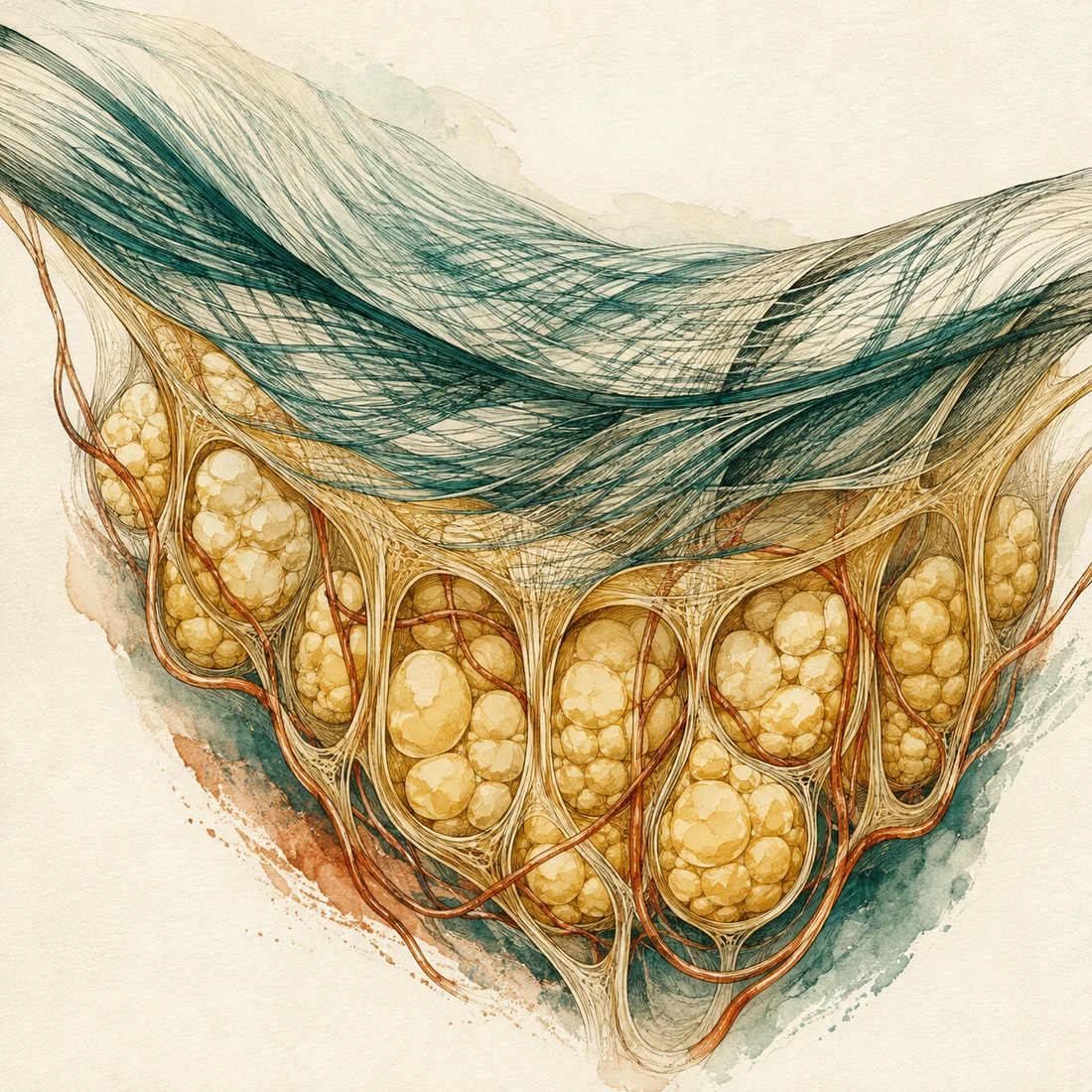
La Ficha 02 mapeó las capas de la piel de fuera hacia dentro. Esta ficha se queda en la última de ellas, la hipodermis, y explica tres estructuras muy citadas en la aparatología estética — el SMAS, los tabiques fibrosos y la grasa subdérmica — que son las que determinan si un tratamiento tensa de verdad o solo cambia el volumen. Fichas 02 mapped the layers of the skin from the outside in. This sheet stays in the last of them, the hypodermis, and explains three structures often cited in aesthetic devices — the SMAS, fibrous septa and subdermal fat — which determine whether a treatment really tightens or only shifts volume.
1. ¿Qué es exactamente el SMAS?What exactly is the SMAS?
El SMAS (Sistema Músculo-Aponeurótico Superficial) es una capa fibromuscular continua que envuelve y conecta los músculos de expresión facial con la piel que hay encima. Se continúa hacia abajo con el platisma, el músculo superficial del cuello. Es, en esencia, el plano de sostén de la cara: cuando un cirujano hace un lifting quirúrgico, no tira de la piel, tira del SMAS. The SMAS (Superficial Musculo-Aponeurotic System) is a continuous fibromuscular layer that wraps around and connects the facial expression muscles to the skin above them. It continues downward into the platysma, the superficial neck muscle. It is, in essence, the support plane of the face: when a surgeon performs a surgical lift, they don't pull on the skin — they pull on the SMAS.
Esto explica por qué los dispositivos de ultrasonido focalizado con visualización ecográfica (como Ultherapy) tienen tanta relevancia clínica pese a ser no invasivos: su profundidad de trabajo más profunda (4,5 mm en rostro) está calculada para llegar exactamente al SMAS, generar puntos de micro-coagulación térmica ahí, e inducir una retracción que imita — a menor escala y sin cirugía — el mismo principio que un lifting quirúrgico. This is why focused-ultrasound devices with real-time ultrasound visualization (like Ultherapy) carry so much clinical relevance despite being non-invasive: their deepest working depth (4.5 mm on the face) is calibrated to reach exactly the SMAS, generate thermal micro-coagulation points there, and induce a retraction that mimics — on a smaller scale and without surgery — the same principle as a surgical lift.
2. Los tabiques fibrosos: sostienen el volumen, no solo lo rellenanFibrous septa: they support volume, not just fill it
La grasa subdérmica no es una masa uniforme: está dividida en compartimentos por tabiques de tejido fibroso que la sujetan en su sitio. Con la edad, estos tabiques pierden tensión y los compartimentos de grasa se desplazan hacia abajo — es una de las razones anatómicas del efecto «caída» facial, junto a la pérdida de volumen óseo y de colágeno. Subdermal fat isn't a uniform mass: it's divided into compartments by fibrous tissue septa that hold it in place. With age, these septa lose tension and the fat compartments shift downward — one of the anatomical reasons behind the facial "drooping" effect, alongside bone volume and collagen loss.
Algunos tratamientos de radiofrecuencia fraccionada con microagujas actúan directamente sobre estos tabiques (retracción térmica de los septos fibrosos, a veces descrita como ATC o «adipose tissue coagulation»): el objetivo no es eliminar grasa, sino retensar la estructura que la sostiene. Some fractional radiofrequency microneedling treatments act directly on these septa (thermal retraction of fibrous septa, sometimes described as ATC, or "adipose tissue coagulation"): the goal isn't to eliminate fat, but to retighten the structure that holds it in place.
| Grasa superficialSuperficial fat | Grasa profundaDeep fat |
|---|---|
| Más cercana a la dermis. Define el contorno visible de la cara y el aspecto «lleno» o «hundido» de una mejilla. Es la más vulnerable a una atrofia no deseada si un aparato de calentamiento profundo se usa con exceso de energía o mala selección de profundidad.Closer to the dermis. Defines the face's visible contour and the "full" or "hollow" look of a cheek. It's the most vulnerable to unwanted atrophy if a deep-heating device is used with excess energy or poor depth selection. | Más próxima al hueso. Cumple una función estructural y de amortiguación, no tanto estética directa. Se ve afectada con menos frecuencia por la aparatología estética de uso habitual en cabina o consulta.Closer to the bone. Serves a structural, cushioning function rather than a direct aesthetic one. Less frequently affected by the aesthetic devices commonly used in clinics or practices. |
En debateUnder debate Una advertencia que se repite entre especialistas: tratar la grasa equivocadaA warning that keeps coming up among specialists: treating the wrong fat
Es una de las advertencias que más se repite entre cirujanos plásticos y dermatólogos que analizan públicamente estos equipos: el uso inexperto de dispositivos con capacidad de calentamiento subdérmico puede inducir atrofia de la grasa superficial en pacientes con poco volumen de partida, hundiendo justo la zona que se quería tensar. No es una cifra contrastada en un ensayo clínico — por eso se presenta aquí como advertencia de criterio profesional, no como dato probado —, pero aparece con la suficiente frecuencia en el debate técnico del sector como para tomarla en serio. This is one of the warnings that comes up most often among plastic surgeons and dermatologists who publicly review this equipment: inexperienced use of devices capable of subdermal heating can induce superficial fat atrophy in patients with little starting volume, hollowing out exactly the area meant to be tightened. It isn't a figure verified in a clinical trial — which is why it's presented here as a professional-judgment warning, not a proven fact — but it comes up often enough in the sector's technical debate to be taken seriously.
Por qué esto importa al leer las fichas de aparatologíaWhy this matters when reading device fact sheets
Cuando en el Bloque 2 leas la ficha técnica de un dispositivo concreto y veas cifras de profundidad y de energía, esta es la anatomía a la que se están refiriendo. Un buen protocolo no es «más energía es mejor»: es elegir la profundidad correcta para la estructura que realmente se quiere tratar. When you read a specific device's spec sheet in Block 2 and see depth and energy figures, this is the anatomy they're referring to. A good protocol isn't "more energy is better" — it's choosing the correct depth for the structure you actually want to treat.
Para quedarte con estoThe takeaway
El SMAS es el plano de sostén facial: tensarlo (con cirugía o con ultrasonido focalizado no invasivo) es lo que produce un efecto de lifting real, no solo superficial.The SMAS is the facial support plane: tightening it (surgically or with non-invasive focused ultrasound) is what produces a real lifting effect, not just a superficial one.
La grasa subdérmica no es homogénea: está dividida en compartimentos por tabiques fibrosos, y algunos tratamientos actúan reforzando esa estructura de sostén en vez de eliminar volumen.Subdermal fat isn't homogeneous: it's divided into compartments by fibrous septa, and some treatments reinforce that support structure instead of removing volume.
Tratar la grasa superficial equivocada con demasiada energía es un riesgo real citado repetidamente por especialistas — una advertencia de criterio profesional, no un dato de ensayo clínico, pero relevante para entender por qué la técnica importa tanto como el aparato.Treating the wrong superficial fat with too much energy is a real risk repeatedly cited by specialists — a professional-judgment warning, not a clinical-trial data point, but relevant to understanding why technique matters as much as the device.
Fichas de estética · serie · Fichas de estética · series · 01 · 02 · 03 · 04 · 05 · 06 · 07 · 08 · 09 · 10 · 11 · 12 · 13 · 14 · 15 · 16 · 17 · 18 · 19 · 20 · 21 · 22 · 23 · 24